Monday, March 19, 2012

Holding onto Morality


In the films Doubt and Crimes and Misdemeanors, we see guilt take a role and question morality.  These two shots, though from different films, are very similar in how they are constructed and what they have to say.  Both are close ups of the hands, both holding a piece of writing and both seem to be expressing a moment of moral clarity, stemming from guilt.

  In the shot above, from the film Doubt we see Father Flynn's hands straightening out his bible, after carefully placing the two small flowers.  Due to the set up of the shot, our eye is drawn towards his finger and the red flower.  The way he is laying out the flowers and bible show him getting things in order.  As he accepts that he must leave the church, he straightens out the desk materials, maybe indicating covering his tracks from whatever the cause of his guilt, and is now ready to move on.

In the shot below, we see Judah Rosenthal reading a letter from Dolores, intended for his wife.  This moment is when his two worlds, one with Dolores and the other with his wife, begin to collide.  The way the shot is constructed, our eye is drawn the the wedding ring on his left hand.  Woody Allen made the deliberate choice to cut to Judah's hands while he read the letter to emphasize this symbol.  This scene is when Judah realizes that his marriage is in jeopardy, and what better way to show this than a wedding ring which is a symbol of commitment, honesty and truth.


These two images represent a moment of moral certainty.  Both characters have a sense of right and wrong in this scene.  Judah, as he reads the letter, becomes stressed and guilty.  He burns the letter, obviously knowing what he did was wrong and would not be accepted by his wife.  He is certain of this moral and knows that he went against it.

Similarly, this is a moment of moral certainty for Father Flynn.  He realizes and begins to accept at this moment that his career at this church is over.  He feels guilty, about what we are uncertain, but feels guilty nonetheless.  He becomes certain that this is the end of the road at this church and that he will be forced to move on.

Sunday, January 29, 2012

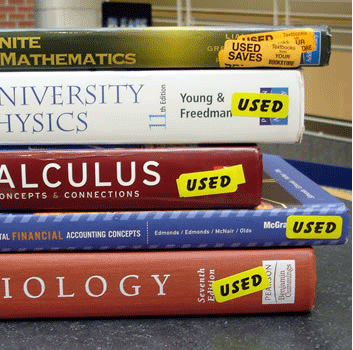
Textbooks Lie

When we read a textbook, we assume it is fact.  We take what we read and don't question it.  We are taught from a very young age that America is the best country to live in.  Obviously, people have more rights in America than in many other countries, but the way the schools teach us is bias.  Looking at how a US History textbook describes WWII is very different than how a textbook in Germany would describe the war.  We read our textbooks and take the information in it as fact, often not taking the biases into account.  Usually these textbooks paint Americans in a better light than other nations. Instead of seeing an objective view of both sides, we only are shown our side of the story.

Not only how an event is described in a textbook is biased, but what information is in the textbook is biased.  Not every event from history can be in a textbook.  This being said, many important parts of history are barely mentioned or not mentioned at all.  Many US History textbooks don't include the start of our nations history, when we essentially wiped out an entire population of Native Americans and took their land.  Often times accounts of WWII include the horrors of concentration camps in Europe, but barely have anything about the internment camps that we had in the United States.  And isn't it convenient how most textbooks don't mention the "Gulf of Tonkin Incident" which was a fake incident that justified Lyndon B. Johnson to enter Vietnam?

Next time you are reading a textbook, think about who wrote it and who the intended audience is.  Though we can learn a lot from textbooks, they must be looked at with speculation because it is nearly impossible for it to be unbiased.