Monday, March 19, 2012

Holding onto Morality


In the films Doubt and Crimes and Misdemeanors, we see guilt take a role and question morality.  These two shots, though from different films, are very similar in how they are constructed and what they have to say.  Both are close ups of the hands, both holding a piece of writing and both seem to be expressing a moment of moral clarity, stemming from guilt.

  In the shot above, from the film Doubt we see Father Flynn's hands straightening out his bible, after carefully placing the two small flowers.  Due to the set up of the shot, our eye is drawn towards his finger and the red flower.  The way he is laying out the flowers and bible show him getting things in order.  As he accepts that he must leave the church, he straightens out the desk materials, maybe indicating covering his tracks from whatever the cause of his guilt, and is now ready to move on.

In the shot below, we see Judah Rosenthal reading a letter from Dolores, intended for his wife.  This moment is when his two worlds, one with Dolores and the other with his wife, begin to collide.  The way the shot is constructed, our eye is drawn the the wedding ring on his left hand.  Woody Allen made the deliberate choice to cut to Judah's hands while he read the letter to emphasize this symbol.  This scene is when Judah realizes that his marriage is in jeopardy, and what better way to show this than a wedding ring which is a symbol of commitment, honesty and truth.


These two images represent a moment of moral certainty.  Both characters have a sense of right and wrong in this scene.  Judah, as he reads the letter, becomes stressed and guilty.  He burns the letter, obviously knowing what he did was wrong and would not be accepted by his wife.  He is certain of this moral and knows that he went against it.

Similarly, this is a moment of moral certainty for Father Flynn.  He realizes and begins to accept at this moment that his career at this church is over.  He feels guilty, about what we are uncertain, but feels guilty nonetheless.  He becomes certain that this is the end of the road at this church and that he will be forced to move on.

Sunday, January 29, 2012

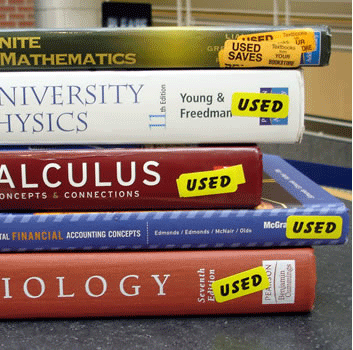
Textbooks Lie

When we read a textbook, we assume it is fact.  We take what we read and don't question it.  We are taught from a very young age that America is the best country to live in.  Obviously, people have more rights in America than in many other countries, but the way the schools teach us is bias.  Looking at how a US History textbook describes WWII is very different than how a textbook in Germany would describe the war.  We read our textbooks and take the information in it as fact, often not taking the biases into account.  Usually these textbooks paint Americans in a better light than other nations. Instead of seeing an objective view of both sides, we only are shown our side of the story.

Not only how an event is described in a textbook is biased, but what information is in the textbook is biased.  Not every event from history can be in a textbook.  This being said, many important parts of history are barely mentioned or not mentioned at all.  Many US History textbooks don't include the start of our nations history, when we essentially wiped out an entire population of Native Americans and took their land.  Often times accounts of WWII include the horrors of concentration camps in Europe, but barely have anything about the internment camps that we had in the United States.  And isn't it convenient how most textbooks don't mention the "Gulf of Tonkin Incident" which was a fake incident that justified Lyndon B. Johnson to enter Vietnam?

Next time you are reading a textbook, think about who wrote it and who the intended audience is.  Though we can learn a lot from textbooks, they must be looked at with speculation because it is nearly impossible for it to be unbiased.

Thursday, December 8, 2011

Never thought I would root for a serial killer

Even though it may be the obvious choice, Hannibal Lecter has to be the greatest monster of all time.  His character, in every sense, is a monster.  He is a cannibal, a serial killer, an animal.  He is a psychopath that gets in the head of his prey before he proceeds to eat their liver with "fava beans and a nice chianti."  The eery way that nothing but his mouth moves as he speaks is haunting.  His focused gaze and smirk are ingrained in our heads.

This, however, is not what makes him such a great monster.  It's his depth as a character.  Unlike Jason, from Friday the Thirteenth, we get to know Lecter and gain a respect for him.  We see his brilliance in psychology and his impressive drawing abilities.  He is shockingly polite and formal.  Unexpectedly, he becomes more human than monster, and we find ourselves rooting for him and fascinated by his presence.

This is what makes him so great.  No one would ever want to be in an open room with Lecter, for fear they may be eaten, but he draws people in.  His very few minutes of screen time are captivating and incredible.  The thought of who he is and what he does is terrifying, but listening to him and watching him is electrifying.

Monday, October 24, 2011

relationship fatale


In Double Indemnity we see the classic portrayal of a femme fatale.  Phyllis Dietrichson is the definition of a femme fatale.  She gets Neff to help her through seduction and uses him.  She is a very one-dimentional character.  We only see her "bad" side where she is trying to kill off characters.

This is in stark contrast to the woman in L.A. Confidential, Lynn Bracken.  Though sometimes classified as a femme fatale, she is not using Bud White or trying to harm him.  Unlike Dietrichson, Bracken is a complex character.  We learn about her childhood and see her room.  We see her break down and cry.  We see her fall in love.  As an audience, we empathize with her.  We see multiple layers of her that we never see with Dietrichson.

The images above describe these two women and their relationships.  The first is of Lynn Bracken and Bud White.  In this shot, we see emotion.  Bud is looking lovingly at Lynn, clearly expressing how he feels about her.  She, though looking off into the distance, looks very content.  They look very comfortable with one another and safe.  The image doesn't give you the impression the Bracken is using White or trying to hurt him.

The lower image is of Phyllis Dietrichson and Walter Neff.  This photo is much harsher.  Neither looks the slightest bit happy.  Dietrichson with the jet black sunglasses looks cold and unapproachable.  She does not seem to be looking at Neff at all.  Neff's eyes are slightly turned towards Dietrichson.  This shows that she is in control.  He is almost looking to her waiting for her next move.  We can really see her power as the femme fatale from this image.  She is drawing Neff in, but clearly wants nothing to do with him.   She uses him.

Sunday, October 2, 2011

Rage vs. Rationality


Throughout The Quitter by Harvey Pekar, illustrated by Dean Haspiel, we see two sides of Harvey.  As Mr. Lawler says in his post "Good Harvey, Bad Harvey", there is a "dichotomy of Harvey", a side prone to being good, and a side prone to being bad.

In this scene above, Harvey is at battle with his own conscience.  His mother had just told him to be the bigger person and apologize to his friend, and Harvey doesn't know how to react.  We see his anger and disagreement on the left side of this image.  On the righthand side, we see his rational side, as he looks to see where his mother is coming from.

When I looked at this shot, I found it interesting that Haspiel drew the two personas back to back, instead of facing one another.  By doing this, it almost frames it in a way to make Harvey look two faced.  It looks like he is going back and forth from one personality to the other and from one direction to the other.  It's almost as if he is turning his back on the "other personality".

The text in this image is also very interesting.  Instead of going back and forth about whether or not he should apologize to his friend, Harvey discusses his mother and her political views.  This takes the attention off him, as if he is trying to cover the fact that he knows he should apologize but doesn't want to.  Instead, he looks at how his mother views the situation, and justifies his actions through her perception of the situation.  This is a clever way of Harvey taking the blame off himself.

The image above is from here.

Tuesday, September 13, 2011

No soup for you!


This picture, is in the scene where John Anderton is trying to hide from the pre-crime cops.  He tries to make himself invisible to heat sensors by cooling his body temperature with ice water.  What was interesting is that the four intersections of the grid each indicate different lighting.  The upper righthand intersection is clearly a place of emphasis, over the lower righthand intersection, as it is lighter and more visible.  It attracts attention to the oddly blue bathtub and the helpless looking Anderton.  It also highlights his bandaged eyes.  The only way to free himself from his identity was by replacing his eyes, and like in Oedipus the King, he seems to gain "insight" by doing so.  He now sees what he must do to outsmart pre-crime.  The top left intersection highlights an odd strip of light, and it automatically grabs our attention because it is the brightest part of the shot.  I think this adds suspension because it shows an entrance for the cops to enter that we would miss otherwise.

This shot is eerily similar to the shot of Agatha in "the soup".  For one, both shots are tinted blue.  It makes me wonder what type of lighting was used here?  It adds an eery feeling because it is not the normal color a bath would look like and it makes the "soup" Agatha is in look more futuristic.  Another similarity is the position of helplessness that Agatha and Anderton are in in these shots.  Agatha is clearly helpless as she is an essential part of pre-crime against her will.  She is not treated as a human and cannot leave on her own terms.  This is also a helpless moment for Anderton.  He is blinded, cannot run from the cops and all he can do is hold his breath and wait.  The scene is very nerve-racking because Anderton is very vulnerable and is also unable to leave on his own terms like Agatha.